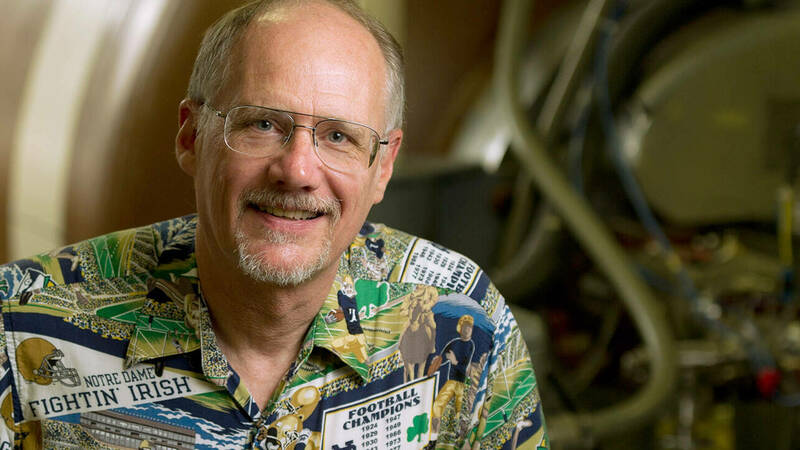
Dave Bartels
Concurrent Professor
- Office
- 203C Radiation Research Building
Notre Dame, IN 46556 - Phone
- +1 574-631-5561
- bartels.5@nd.edu
Research Areas
- Physical/Analytical Chemistry
Research Specialties
- Energy
- Measurement
Prospective Graduate Students
Biography
| Year | Title |
|---|---|
| 2003-present | Notre Dame Radiation Laboratory |
| 1985-2003 | Argonne National Laboratory |
| 1982 | Ph.D., Northwestern University |
| 1977 | B.A., Hope College |
Research Interests
Fast Kinetics of Free Radical Reactions â Free radicals are generated in virtually all radiation-initiated processes, and are responsible for most of the permanent chemical changes. The recombination reactions are often diffusion limited or nearly so, but also depend on pairing of spin to produce stable singlet products. This gives rise to the fascinating Chemically Induced Dynamic Electron Polarization (CIDEP) phenomenon in their time-resolved EPR spectra, and Chemically Induced Dynamic Nuclear Polarization (CIDNP) in NMR spectra of the recombination products, where some lines appear with negative phase due to population inversions.
Radiation Chemistry and Photochemistry of Water â To ionize water molecules in the gas phase requires at least 12.6 eV of energy, but dissociation of water to produce (H+)aq, (e-)aq, and OH radicals can be accomplished in liquid water with 6 eV photons in a photochemical event that is still not well understood. What is the nature of electronically excited liquid water, and how can we explain the escape yields of H atoms, OH radicals, and solvated electrons?
Solvent Effects on Reaction Rates in Supercritical Water â Supercritical water is proposed as the coolant for efficient Generation-IV nuclear reactors, and is the medium for an important advanced oxidation technology for hazardous waste destruction. The properties of water change dramatically in the supercritical region as the water density changes continuously between zero and 1 g/cc. The primary free radicals in water – hydrated electrons, H atoms, and OH radicals – are respectively ionic, hydrophobic, and dipolar, providing opportunity to investigate nearly all possible solvent effects using radiolysis excitation. Many strange effects are being found, such as rate constants that decrease as the temperature is raised.
Selected Publications
- Narvaez, W. A.; Bartels, D. M. and Thompson, W. H. "Assessing the Limitations of Self-Interaction-Corrected Functionals for Describing the Hydrated Electron" 2026 Journal of Chemical Theory and Computation, in press. DOI: 10.1021/acs.jctc.6c00234.
- Conrad, J. K.; Bruggeman, C. and Bartels, D. M. "Pulse Radiolysis and Transient Absorption Spectra of Aqueous Solutions of Sodium Sulfamate" 2026 Radiation Physics and Chemistry, 247, 113990. DOI: 10.1016/j.radphyschem.2026.113990.
- Bartels, D. M. and Thompson, W. H. "Reactivity of the Hydrated Electron" 2026 Annual Review of Physical Chemistry, 77 (1), pp.43–60. DOI: 10.1146/annurev-physchem-082324-104448.
- Lee, H.; Bartels, D. M. and McClarren, R. G. "Electron Transport (0.2 eV-10 keV) in Liquid Water: Resolving Discrepancies between Track Simulations and Radiolysis Data" 2026 RSC Advances, 16 (22), pp.20065–20086. DOI: 10.1039/d6ra00710d.
- Medina-Garcia, J. A.; Rogalski, M. H.; Cooper, W. J.; Bartels, D. M.; O'Shea, K. E. and Mezyk, S. P. "Kinetics of Haloacetaldehydes' Reactions with Radicals Produced in Radiolysis of Water" 2026 ACS ES&T Water, 6 (3), pp.1915–1924. DOI: 10.1021/acsestwater.5c01382.
- Lee, H.; Bartels, D. M. and Mcclarren, R. G. "Toward a Comprehensive Understanding of Low-Energy Electron Energy Loss Spectra of Amorphous Ice" 2025 Journal of Physical Chemistry Letters, 16 (46), pp.12068–12073. DOI: 10.1021/acs.jpclett.5c02825.