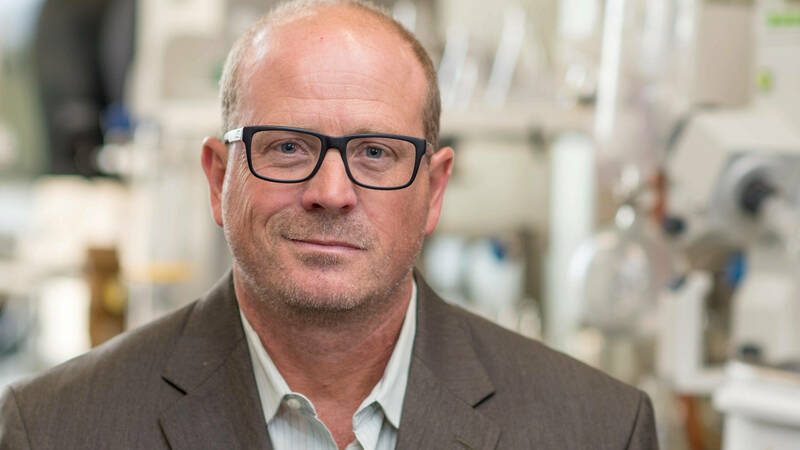
Brian Blagg
Charles Huisking Professor; Director, Warren Center for Drug Discovery and Development
- Office
- 305G McCourtney Hall - West
Notre Dame, IN 46556 - bblagg@nd.edu
Research Areas
- Biochemistry
- Organic Chemistry
Research Specialties
- Life Processes
- Medicine
- Synthesis
Prospective Graduate Students
Biography
| Year | Title |
|---|---|
| 2017-Present | Director, Warren Family Research Center for Drug Discovery and Development, University of Notre Dame |
| 2017-Present | Charles Huisking Professor of Chemistry and Biochemistry, University of Notre Dame |
| 2014-2017 | Lester and Betty Mitscher Professor, University of Kansas |
| 2010-2017 | Professor of Medicinal Chemistry, University of Kansas |
| 2007-2010 | Associate Professor of Medicinal Chemistry, University of Kansas |
| 2002-2007 | Assistant Professor of Medicinal Chemistry, University of Kansas |
| 1999-2002 | NIH Postdoctoral Fellow, The Scripps Research Institute |
| 1999 | Ph.D. in Organic Chemistry, University of Utah |
| 1994 | B.A. in Chemistry and Environmental Studies, Sonoma State University |
Co-founder, Grannus Therapeutics
Editorships
2018-Present Editorial Board, International Journal of Molecular Sciences
2011-2021 Associate Editor, The Journal of Medicinal Chemistry
2010-Present Editorial Consulting Board, Bioorganic and Medicinal Chemistry
2010-Present Editorial Consulting Board, Bioorganic and Medicinal Chemistry Letters
2009-Present Editorial Advisory Board, ACS Medicinal Chemistry Letters
2008-Present Editorial Board, Future Medicinal Chemistry
2007-Present Editorial Board, Perspectives in Medicinal Chemistry
Selected Awards
2026 1st Source Faculty Commercialization Award
2025 Senior Fellow, Cell Stress Society International
2025 Len Neckers Research Innovation Award, Cell Stress Society International
2023 Cathy and Paul Douglas Scholar in Alzheimer's Discovery
2015 Baxendale Innovation Award, University of Kansas
2013 Leading Light Award, University of Kansas
2012 Kentucky Colonel
2011 University of Kansas Scholarly Achievement Award
2009 American Chemical Society David W. Robertson Award in Medicinal Chemistry
2006 American Cancer Society Research Scholar Award
2006 Faculty of 1000, Biology
2005 University of Kansas Outstanding Teacher
Research Interests
The 90 kDa heat shock proteins (Hsp90) are molecular chaperones that are required for the refolding of denatured proteins and the maturation of nascent polypeptides into their biologically active, three-dimensional structures. In fact, numerous proteins represented in all ten hallmarks of cancer are dependent upon Hsp90 for conformational maturation. Hsp90 inhibition provides a combinatorial attack on multiple pathways responsible for malignant cell growth and proliferation. Consequently, Hsp90 has emerged as a promising target for the development of cancer chemotherapeutics.
Hsp90 contains two ATP binding sites, and in order to fold nascent polypeptides into biologically active proteins, Hsp90 catalyzes the hydrolysis of ATP. ATP hydrolysis provides the Hsp90 protein folding machinery the requisite energy for folding "client" proteins into their correct three-dimensional conformation. Disruption of this folding process results in the destabilization of Hsp90 "client" protein complexes, which leads to ubiquitinylation and proteasome-mediated degradation of the protein substrate.
The N-terminal ATP binding site is inhibited by the natural products geldanamycin (GDA) and radicicol (RDC). Numerous (~20) analogs of these natural products as well as the nucleotide itself have undergone clinical evaluation for the potential treatment of cancer. Unfortunately, the vast majority of these molecules have failed. The current hypothesis is that on-target toxicities are produced when all four Hsp90 isoforms are targeted simultaneously. Therefore, we are working towards the development of the first isoform selective Hsp90 inhibitors and have produced the first Grp94-selective inhibitor and most recently, the first Hsp90β-selective inhibitor. Both of these manifest biological activities that are likely to be useful for the treatment of disease.
The C-terminal ATP binding site was identified by one of our collaborators, Len Neckers (National Cancer Institute), who demonstrated that the coumarin antibiotics, including novobiocin, inhibit the C-terminal ATP binding site and lead to the degradation of Hsp90 client proteins similarly to N-terminal inhibitors. Unfortunately, novobiocin's activity is not sufficient for further clinical evaluation and thus represents an opportunity to develop more efficacious Hsp90 inhibitors. We have developed the most potent C-terminal inhibitors of Hsp90 yet discovered and have demonstrated the Hsp90 inhibitors possess potent neuroprotective activities against Alzheimer's, Parkinson's, diabetic peripheral neuropathy, and Multiple Sclerosis. Through optimization of the scaffold, we have produced a neuroprotective agent that is currently in Phase I human clinical trials for neuropathy.
The major goals for members of the Blagg Research Team are to design, synthesize, and evaluate novel inhibitors of the Hsp90 protein folding process. To achieve these goals, we use computer modeling to design new molecules that bind these ATP-binding sites, we develop new organic reactions that allow access to the desired compounds in a highly efficient manner, and finally we develop assays that are suitable for determining the biological effects of our rationally designed Hsp90 inhibitors. We are currently engaged in more than 50 collaborative studies with researchers throughout the world!
Selected Publications
- Jiang, X. S. and Blagg, B. "The Evolution of Heat Shock Protein 90 C-Terminal Inhibitors: From Novobiocin to Potential Clinical Candidates" 2026 Cell Stress & Chaperones, 31 (3), 100165. DOI: 10.1016/j.cstres.2026.100165.
- Reynolds, T. S.; Mersich, I. and Blagg, B. "Cell-Impermeable Hsp90α-Selective Inhibitor NDNA4 Inhibits Cancer Cell Migration and Targets Extracellular Hsp90α's Critical F-5 Fragment" 2026 ACS Chemical Biology, 21 (4), pp.876–885. DOI: 10.1021/acschembio.6c00125.
- Catalfano, K. C.; Rakonick, M. H. and Blagg, B. "Optimization of Triazole-Based Small Molecule Disruptors of the Aha1/Hsp90 Complex that Manifest Potent Activities" 2026 European Journal of Medicinal Chemistry, 308, 118612. DOI: 10.1016/j.ejmech.2026.118612.
- D'Amico, T.; Reynolds, T. S.; Serwetnyk, M. A. and Blagg, B. "Attempts to Achieve Targeted Covalent Inhibition of Hsp90β" 2026 Chemical Biology & Drug Design, 107 (4), e70290. DOI: 10.1111/cbdd.70290.
- Nguyen, M.; Nikenich, M. R.; Seifert, K.; Pinkenburg, C.; Lai, F. L.; Walther, H. L.; Hartmann, M.; Szulc, A.; Sparkes, E.; Chen, S. H.; Wikramanayake, R.; Bernaus-Esqué, M.; Liu, Y. J.; Tebar, F.; Serwetnyk, M.; Wenninger, A.; Patzke, C.; Blagg, B.; Ashfeld, B. L.; Groundwater, P. W.; Hibbs, D. E.; Hoy, A. J.; Rentero, C.; Enrich, C.; Cho, A. N.; Du, J. J. and Grewal, T. "Small Molecules to Elevate Rab7-GTPase Activity and Lower Cholesterol Accumulation in Niemann-Pick Type C Disease" 2026 Pharmaceutical Research, 43 (4), pp.1009–1031. DOI: 10.1007/s11095-026-04058-8.
- Xu, H.; Huard, D.; Dunn, E.; Chalfoun, L. A.; Adulley, F.; Lieberman, R. L. and Blagg, B. "Design, Synthesis, and Biological Properties Exhibited by 1,2,3-Triazole Based Grp94-Selective Inhibitors" 2026 European Journal of Medicinal Chemistry, 303, 118394. DOI: 10.1016/j.ejmech.2025.118394.